Most Tolerant Cat Breeds for Active Kids, A Ragdoll stretched out on the sofa, a Maine Coon chasing a feather toy and a British Shorthair quietly watching the family from a chair could all be perfectly content in homes with children. But they might have very different ideas about how much attention they want.
If you’re choosing a cat for a lively household, Ragdolls, RagaMuffins, Maine Coons, Birmans, American Shorthairs and Burmese cats are among the breeds worth considering. Abyssinians and Siberians may appeal to families who enjoy interactive play, while British Shorthairs and Norwegian Forest Cats can suit children who respect a more independent companion.
The most tolerant cat breeds for active kids are not necessarily the cats that allow the most handling. They’re cats whose individual personalities, confidence and activity needs fit the family.
No breed is guaranteed to enjoy toddlers, tolerate being carried or refrain from scratching. Cats Protection’s advice on choosing cats for children recommends considering how a particular animal responds to handling, noise, visitors and unfamiliar situations.
Before choosing from the ten breeds below, think about your children’s ages, how they play and whether your home offers the cat somewhere peaceful to retreat.
Table of contents
- Quick comparison: Which cat might suit your family?
- 1. Ragdoll — for families seeking a relaxed companion
- 2. RagaMuffin — for affectionate families
- 3. Maine Coon — for active school-aged children
- 4. Birman — for gentle play and companionship
- 5. American Shorthair — for busy households with changing routines
- 6. Burmese — for families who enjoy an involved companion
- 7. British Shorthair — for children who understand independence
- 8. Abyssinian — for children who love active play
- 9. Siberian — for active families with space to climb
- 10. Norwegian Forest Cat — for families who appreciate a self-directed companion
- Family compatibility and handling matrix
- What makes a cat genuinely suitable for children?
- Kid-friendly cat breeds that don’t scratch: Can any breed guarantee that?
- How to introduce a kitten to a toddler safely
- How to make an active household more comfortable for cats
- How to tell when a cat needs a break
- Is an adult rescue cat better than a pedigree kitten?
- Questions to ask before adopting or buying a cat
- Frequently asked questions
- Choosing a cat your family can genuinely live with
Quick comparison: Which cat might suit your family?
| Cat breed | Typical characteristics | Household that may suit it |
|---|---|---|
| Ragdoll | Placid, affectionate, moderately active | Families wanting quiet companionship |
| RagaMuffin | Docile, sociable, playful | Families who enjoy gentle interaction |
| Maine Coon | Gentle, easygoing, active | School-aged children who enjoy games |
| Birman | Sweet, affectionate, sociable | Families wanting play and calm company |
| American Shorthair | Even-tempered, playful, independent | Busy homes with varied routines |
| Burmese | People-oriented, affectionate, curious | Families who provide regular attention |
| British Shorthair | Quiet, relaxed, relatively independent | Children who respect personal space |
| Abyssinian | Highly active, curious, affectionate | Older children who enjoy active play |
| Siberian | Sociable, intelligent, inquisitive | Active homes with climbing opportunities |
| Norwegian Forest Cat | Independent, intelligent, active | Families who appreciate a self-directed cat |
These are broad breed descriptions rather than measured tolerance or safety ratings. The actual cat you meet may behave differently.
1. Ragdoll — for families seeking a relaxed companion
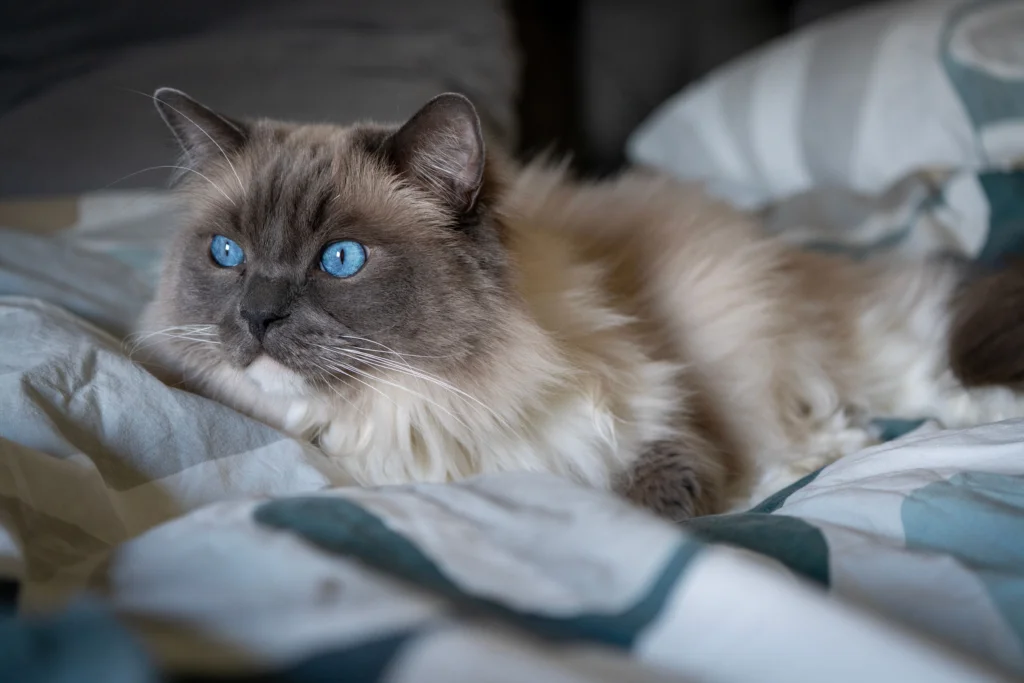
Ragdolls have earned a reputation for being gentle, affectionate companions. Their large size, soft semi-long coat and blue eyes are distinctive, but temperament is the more important consideration for a family.
The Cat Fanciers’ Association’s Ragdoll profile describes the breed as moderately active, sociable and generally adaptable. Ragdolls often enjoy attention and play without requiring constant energetic activity.
That may work for children who want a cat nearby while reading, watching television or relaxing after school.
However, the breed’s name can encourage an unfortunate misconception: Ragdolls should not be treated as floppy toys. Even if an individual cat relaxes when held, it can still feel fear, discomfort or pain.
A toddler who squeezes the cat or suddenly lifts it can cause distress or injury.
Are Ragdoll cats good with toddlers and babies?
A well-socialised Ragdoll with a suitable temperament may live happily in a family with young children. That doesn’t make it safe to leave the cat alone with a baby or toddler.
Young children should have direct adult supervision whenever they interact with a cat. Babies need a protected sleeping space that cats cannot access.
Ragdolls may be particularly appealing to families seeking calm companionship, provided adults enforce boundaries and never assume the cat’s gentle disposition makes rough handling acceptable.
Best match: Families who can supervise young children and offer affectionate, low-pressure interaction.
Potential difficulty: Long-coat maintenance, substantial adult size and the risk of children treating a placid cat as a toy.
2. RagaMuffin — for affectionate families
RagaMuffins are closely related historically to Ragdolls but are recognised as a distinct breed.
The CFA RagaMuffin profile describes them as docile, people-loving and affectionate. Some also enjoy games and can learn activities such as retrieving toys.
This combination may appeal to families wanting a cat that enjoys being around people without being constantly on the move.
A RagaMuffin might choose to sit beside a child during quiet activities or participate in a short play session. Its willingness to approach family members can make it easier for children to enjoy companionship without trying to force contact.
Still, the breed’s trusting reputation is not permission for children to dress it up, restrain it or carry it around.
A cat remaining still does not necessarily mean it is enjoying the interaction.
Children should learn to notice when the cat turns away, moves towards a hiding place or shows signs of tension.
Best match: Families who enjoy gentle petting and relaxed time together.
Potential difficulty: Grooming needs and managing children’s expectations about cuddling.
3. Maine Coon — for active school-aged children
Maine Coons are among the larger pedigree cat breeds, with substantial bodies and long, shaggy coats.
According to the CFA Maine Coon profile, they are generally gentle, easygoing and active. The breed is also described as sociable and interested in household activities.
That combination makes Maine Coons appealing to children who want to play with a cat rather than simply hold one.
A school-aged child could roll a lightweight ball across the floor, move a suitable wand toy or help an adult set up simple play opportunities.
Because Maine Coons can be physically large, children must not assume they’re easy to lift. An adult cat may be heavier and more difficult to support securely than expected.
Regular grooming is another consideration. Parents should be prepared to manage coat care rather than expecting young children to take responsibility for it.
Best match: Active families with school-aged children who understand gentle handling.
Potential difficulty: Grooming, climbing-space needs and the practical challenges of handling a large cat.
4. Birman — for gentle play and companionship
Birmans are known for their blue eyes, colour-pointed coats and distinctive white paws.
Their personality may be especially appealing to families looking for a balance between playful activity and quieter companionship.
The CFA Birman breed profile describes them as sweet and affectionate.
A Birman may enjoy spending time near family members, following activities around the house or taking part in toy-based play.
Children who enjoy reading beside a cat or offering short, supervised games may appreciate this temperament.
However, even a sociable Birman needs privacy. If the household becomes busy with visitors or several children are playing loudly, the cat must be free to retreat.
Provide a comfortable bed or elevated resting place where it will not be disturbed.
Best match: Families wanting affection and manageable play opportunities.
Potential difficulty: Regular coat care and the need for children to respect quiet time.
5. American Shorthair — for busy households with changing routines
American Shorthairs are generally described as even-tempered, independent and affectionate.
The CFA American Shorthair profile highlights the breed’s interest in interactive games as well as its ability to occupy itself.
For a family with school runs, homework, visitors and weekend activities, that combination can be attractive.
An American Shorthair may enjoy a lively play session and then settle somewhere quiet when the household is occupied.
Its short coat can be easier to maintain than some longhaired coats, although regular care is still needed.
There is an important distinction when adopting: an American Shorthair is a recognised pedigree breed. A domestic shorthair is a general description for a short-coated cat, often without pedigree ancestry.
A domestic shorthair with a confident temperament and positive history around children may be equally suitable.
Best match: Families wanting a companion that enjoys games but does not depend on constant physical attention.
Potential difficulty: Assuming that independence means the cat needs little enrichment or social contact.
6. Burmese — for families who enjoy an involved companion
Burmese cats are frequently described as particularly people-oriented.
The CFA Burmese profile describes a curious, affectionate breed that often enjoys family life and interaction with children.
Unlike cats that prefer observing activities from another room, a sociable Burmese may seek opportunities to participate.
That can appeal to children who enjoy playing with pets and spending time with them throughout the day.
The household must still provide appropriate rest and quiet areas. A child who continually follows the cat or insists on picking it up can turn otherwise positive interaction into stress.
Burmese cats may be better suited to families that can offer regular attention and play rather than households where the cat would be expected to entertain itself for extended periods.
Best match: Families who enjoy frequent, supervised companionship.
Potential difficulty: Meeting the needs of a highly social individual while protecting its boundaries.
7. British Shorthair — for children who understand independence
A British Shorthair’s round face and plush coat may make it look like a cuddly toy.
Its typical preferences tell a different story.
The CFA British Shorthair profile describes the breed as quiet, calm and interested in people, while noting that many prefer keeping their paws on the floor.
A British Shorthair may enjoy sitting beside a family member without wanting to be lifted.
This makes the breed worth considering for older children who understand that affection doesn’t always mean physical contact.
Parents of toddlers should be especially careful not to let children corner or carry the cat. An animal that prefers distance may become frightened if it cannot escape.
Best match: Families who appreciate calm companionship and allow the cat to initiate contact.
Potential difficulty: Children expecting a lap cat that enjoys being carried.
8. Abyssinian — for children who love active play
If your children dream of teaching a cat games or watching it explore climbing structures, an Abyssinian may appeal to them.
The CFA Abyssinian profile describes this breed as highly active, inquisitive and affectionate.
Abyssinians are often interested in exploring their surroundings and investigating changes.
They need opportunities for movement and mental stimulation. Suitable toys, climbing areas and supervised games can help channel that activity.
This doesn’t necessarily make them suitable for every energetic child.
An Abyssinian that enjoys running after a toy may strongly dislike being held still for cuddles.
Families with very young children should consider whether they can reliably protect an active cat from chasing and unwanted restraint.
Best match: Older children who enjoy interactive play and can recognise when the cat wants to stop.
Potential difficulty: High enrichment needs and limited interest in prolonged cuddling.
9. Siberian — for active families with space to climb
Siberians have powerful builds, dense coats and a reputation for being curious and sociable.
The CFA Siberian profile describes them as intelligent, devoted and interested in their surroundings.
A Siberian may enjoy investigating household activities and using climbing structures.
Families considering this breed should provide stable, secure furniture for climbing and quiet places away from children.
Their substantial coats also require attention. Parents should discuss grooming expectations before adopting, particularly if children are hoping for a low-maintenance pet.
Siberians are sometimes advertised as suitable for people with cat allergies. Families should not assume any breed is allergy-free; individual reactions and allergen exposure vary.
Best match: Families who can provide play, climbing opportunities and regular coat care.
Potential difficulty: Grooming, space requirements and unrealistic expectations about allergies.
10. Norwegian Forest Cat — for families who appreciate a self-directed companion
Norwegian Forest Cats are large, sturdy animals with dense coats and a strong climbing instinct.
The CFA Norwegian Forest Cat profile describes them as active, sweet and independent.
A Norwegian Forest Cat may enjoy joining family activities without constantly seeking cuddles.
For an older child, that can offer a valuable opportunity to learn that animals have individual preferences.
Instead of lifting the cat or demanding attention, the child can offer a toy, sit nearby or wait for the cat to approach.
Homes should include secure climbing structures and private resting areas.
Children should understand that a large cat still needs gentle handling and cannot safely be treated as physically indestructible.
Best match: Families with older children who enjoy play but respect independence.
Potential difficulty: Coat maintenance, climbing needs and unwanted handling.
Family compatibility and handling matrix
The matrix below groups the ten breeds by broad temperament patterns. It is a decision aid, not a scientific measurement of tolerance or aggression.
| Temperament category | Breed examples | Possible response when uncomfortable | Best household match | Parental supervision rule |
|---|---|---|---|---|
| Placid and generally relaxed | Ragdoll, RagaMuffin, Birman | May withdraw, freeze, hide or avoid contact | Families with younger children learning gentle interaction | Provide accessible escape routes; never interpret stillness as automatic consent |
| Social and playful | Maine Coon, Burmese, American Shorthair, Abyssinian | May stop participating, move away or show signs of overstimulation | Families with school-aged children who enjoy games | Use toys rather than hands; end play when the cat disengages |
| Calm and quieter | British Shorthair, some individual Ragdolls | May prefer sitting nearby or leaving a busy room | Families with children who respect independent space | Do not force cuddling or carrying; protect resting areas |
| Active and relatively independent | Siberian, Norwegian Forest Cat | May climb away, avoid contact or retreat to a quiet area | Homes with older children and climbing opportunities | Keep elevated refuges and retreat routes clear |
A placid breed is not automatically suitable for a toddler. The more useful question is whether the particular cat is comfortable with normal family activity and can escape unwanted attention.
What makes a cat genuinely suitable for children?
A cat’s behaviour during everyday activities often tells you more than a breed description.
When meeting a prospective family cat, look at how it responds to people without forcing an interaction.
Confidence around new people
A confident cat may investigate a visitor or remain reasonably relaxed when someone enters the room.
That does not mean you should deliberately make loud noises to test it.
Ask the rescue centre or breeder what they have observed during ordinary daily routines.
A positive history with children
An adult cat that has previously lived happily with young children may be easier to match to a family than a kitten whose preferences have not fully developed.
According to Battersea’s guidance on choosing a cat for a family, a suitable cat is generally confident, friendly, relatively relaxed and comfortable with gentle handling.
Previous positive experiences with children are especially useful.
Willingness to approach voluntarily
A cat that chooses to approach people may be more comfortable with companionship than one that consistently hides or avoids contact.
But approaching is not blanket permission to pick it up.
Watch whether the animal remains relaxed and can leave whenever it chooses.
Ability to cope with the household environment
A noisy home isn’t automatically unsuitable for cats. Some individuals cope well with regular activity, while others become stressed.
Consider the size of the house, whether the cat will have a private room and whether your children can follow basic rules.
A timid cat deserves a quieter match rather than being expected to become more tolerant through repeated exposure to stressful handling.
Kid-friendly cat breeds that don’t scratch: Can any breed guarantee that?
No. There is no cat breed that can be guaranteed never to scratch a child.
Even generally affectionate cats can scratch or bite when frightened, injured, trapped or handled too roughly.
Scratching posts are also important because claw maintenance and territorial marking are normal feline behaviours. That is different from a defensive scratch directed at a person.
The aim should be to reduce the circumstances that provoke defensive reactions.
Children should never use their fingers as toys, grab the cat’s tail or corner it underneath furniture.
Adults should supervise play and give the cat a clear way to withdraw.
The US Centers for Disease Control and Prevention recommends supervising children around cats, avoiding rough play and cleaning bites or scratches promptly.
If a child is bitten or scratched, wash the wound with soap and running water. Seek prompt medical advice for a puncture wound, serious injury, signs of infection or concerns about the animal’s health or vaccination history. Follow locally applicable medical guidance.
Never punish a cat for showing fear. Instead, end the interaction and identify what made the animal uncomfortable.
How to introduce a kitten to a toddler safely
Introducing a kitten to a toddler requires more than placing them in the same room and hoping they’ll become friends.
Kittens are small and vulnerable. Toddlers can move suddenly, become excited and struggle to control the force of their hands.
A gradual introduction protects both.
Step 1: Prepare a child-free settling room
Before bringing the kitten home, provide a quiet room with an appropriate bed, water, food, litter tray, scratching surface, hiding places and suitable toys.
Allow the kitten to become comfortable with its new surroundings and adult caregivers before meeting young children.
Don’t pull the kitten out from behind furniture or carry it towards a toddler who is eager to pet it.
Step 2: Teach simple rules before the meeting
Start with three understandable messages: gentle hands, quiet voices and let the cat walk away.
Practice using a toy animal if necessary.
Tell your child that sleeping, eating, drinking, hiding and using the litter tray are private activities for the cat.
For very young children, adults must enforce the rules because verbal understanding may not translate into reliable behaviour.
Step 3: Arrange a calm first meeting
Ask the child to sit quietly. A safety gate or playpen may help prevent sudden grabbing.
Allow the kitten to enter voluntarily and investigate its surroundings.
At first, the child can simply watch.
Battersea’s guide to introducing cats to babies and children recommends letting the animal settle, keeping meetings calm and allowing the cat to approach rather than forcing contact.
Step 4: Allow the kitten to choose contact
If the kitten approaches and appears comfortable, an adult can guide a short, gentle interaction.
For a child old enough to follow instructions, brief strokes around an area the kitten enjoys may be appropriate.
Avoid grabbing, hugging, tail-pulling and touching the belly.
If the kitten turns away or leaves, allow it to go.
Step 5: Introduce distance-based play
Instead of encouraging the toddler to touch the kitten repeatedly, try an age-appropriate game controlled by an adult.
A suitable wand toy allows interaction without placing little fingers directly in front of the kitten’s claws.
Keep strings and detachable toy parts away from unsupervised children and pets.
Step 6: Build familiarity gradually
Repeat short, positive meetings.
If the kitten hides, freezes, hisses or tries to escape, stop and provide space. Don’t extend a meeting just because the child is enjoying it.
Young children and cats should never be left together without direct adult supervision, even when previous interactions have been calm.
How to make an active household more comfortable for cats
Choosing the right breed is only part of creating a successful family home.
A cat also needs an environment where it can control its exposure to people, noise and activity.
Provide elevated escape places
A secure cat tree or well-installed climbing shelf offers the cat somewhere to retreat.
For families with toddlers, provide at least one refuge that the child cannot access.
The structure should be stable, and the cat should be able to reach it without passing through a crowded play area.
Elevated spaces are useful, but they should not replace a quiet room or accessible hiding places.
Protect sleeping and eating areas
Children should never disturb a cat that is sleeping, eating, drinking or using the litter tray.
These rules should apply to visiting children as well as household members.
Keep feeding and toileting facilities in areas young children cannot interfere with.
Make carrying off-limits to young children
Young children should not carry cats around the house.
A sudden struggle can result in a fall, injury or defensive scratch.
Older children who are physically capable of lifting a cat should only learn suitable handling with adult instruction and when the individual cat is comfortable.
Being affectionate does not mean a cat wants to be picked up.
Give children appropriate ways to participate
Instead of asking a child to cuddle the cat, involve them in activities that suit the animal.
Older children might help organise toys, supervise a rolling-ball game or refill water under adult guidance.
Young children can watch a cat play or help choose a suitable toy with adult supervision.
The goal is enjoyable contact without placing pressure on the cat.
Battersea’s guidance on creating a cat-friendly home explains the importance of providing environments that support natural behaviour, security and positive experiences.
How to tell when a cat needs a break
Some signs of discomfort are obvious. Others are easy to miss, especially for children.
A cat may hiss or swat when it feels threatened, but there can be earlier changes in posture and behaviour.
| Cat behaviour | Possible meaning | Appropriate response |
|---|---|---|
| Approaches with relaxed posture | May welcome interaction | Offer brief contact and keep watching |
| Walks away or turns its head | May want distance | Stop touching and allow departure |
| Ears move sideways or backwards | Possible tension or discomfort | End the interaction |
| Tail flicks rapidly or lashes | Possible agitation | Stop play or petting |
| Freezes, crouches or hides | Possible fear or stress | Give space; keep children away |
| Hisses, growls, swats or bites | Strong warning or defensive behaviour | Separate calmly without punishment |
One body-language sign rarely tells the whole story. Consider the cat’s usual behaviour, surrounding events and other signals.
If the cat begins avoiding family members, hiding more often or showing persistent changes in its normal behaviour, consult a veterinary professional. Pain and illness can contribute to behaviour changes, so don’t assume the problem is simply a dislike of children.
Is an adult rescue cat better than a pedigree kitten?
For some families, especially those with toddlers, an adult cat with a known history may be a better match than a kitten.
Kittens are still developing their personalities and learning how to interact with people. They may be lively, easily startled and physically vulnerable.
An adult cat’s behaviour may be more established.
Rescue staff may know whether it has lived with young children, enjoys gentle contact or finds noisy environments stressful.
Cats Protection’s choosing-a-cat guidance notes that adult cats can be calmer and that a cat’s previous experiences and personality are important considerations for families.
A domestic moggy should not be overlooked simply because it lacks a pedigree.
The strongest match is the individual cat whose needs and preferences fit your household.
Questions to ask before adopting or buying a cat
Before agreeing to bring a cat home, discuss its background with the rescue centre or breeder.
Ask how it responds to unfamiliar people, whether it has lived with children, what sorts of handling it enjoys and how it behaves when frightened or overstimulated.
Find out whether the cat has access to quiet spaces and whether its usual behaviour has changed recently.
For a pedigree cat, ask about relevant inherited health conditions, appropriate health screening, veterinary care and how the kittens have been socialised.
Don’t accept a seller’s promise that a kitten is guaranteed never to bite or scratch.
A responsible source should be comfortable discussing the cat’s individual behaviour and any reasons your home might not be suitable.
Frequently asked questions
Maine Coons, Burmese cats and Abyssinians may appeal to families that enjoy interactive games. However, a highly energetic child must still be taught not to chase, grab or restrain a cat. Individual temperament and adult supervision are more important than selecting the most active breed.
Ragdolls, RagaMuffins, Birmans and Burmese cats are commonly described as affectionate. A well-socialised adult cat with a positive history around children may be an even stronger choice. Affection should always be voluntary.
Not necessarily. A large Maine Coon or Siberian may appear sturdy, but size is not a reliable measure of emotional tolerance. Rough handling can frighten or injure any cat.
The term hardy usually describes physical characteristics or robustness, not willingness to tolerate noise or handling. A large, strong cat may still need considerable grooming, enrichment and privacy. Match the individual cat to the household rather than relying on a description of physical strength.
Sex alone is not a reliable predictor of how a cat will behave around children. Personality, socialisation, life experience and the household environment deserve more attention.
No. A baby should sleep in a protected cot or bassinet that the cat cannot access. Never leave a baby and cat together without direct adult supervision.
Provide a quiet, child-free refuge and stop attempts to make the cat interact. Review whether the children are approaching too quickly, making loud noises or blocking escape routes. If hiding persists or appears alongside changes in eating, toileting or other normal behaviour, seek veterinary advice.
Choosing a cat your family can genuinely live with
For a family that enjoys active play, a Maine Coon, Burmese, American Shorthair or Abyssinian may be worth meeting. If you prefer a quieter companion, a Ragdoll, RagaMuffin, Birman or British Shorthair might be more suitable.
But don’t select a cat from a breed profile alone.
Meet the individual animal, ask about its experiences with children and consider whether your family can respect its preferences. Make sure everyone understands that a cat can choose when to approach and when to leave.
A successful family cat isn’t one that endures everything children do. It’s one that can feel secure, behave naturally and enjoy family life without being overwhelmed.