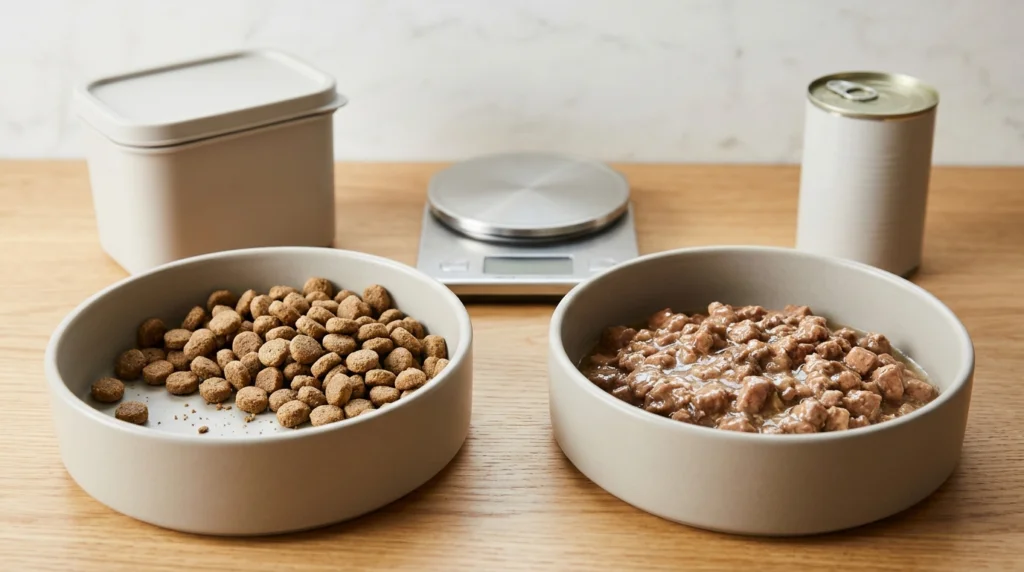
Quick Answer: To convert any dog food Guaranteed Analysis nutrient to Dry Matter Basis (DMB), subtract Moisture % from 100 to find total Dry Matter %, then divide the labeled nutrient % by Dry Matter % and multiply by 100: Nutrient % (DMB) = [As-Fed % ÷ (100 − Moisture %)] × 100. For example, a canned diet labeled 8% crude fat at 78% moisture actually delivers 36.4% fat DMB—more than double a 14% fat dry kibble at 10% moisture (15.6% fat DMB).
Dog Food Dry Matter Basis (DMB) & Guaranteed Analysis Calculator
Eliminate water dilution from pet food labels. Convert as-fed guaranteed analysis to true Dry Matter Basis (DMB), estimate Nitrogen-Free Extract (NFE) carbohydrates, calculate Modified Atwater metabolizable energy, and screen dietary fat tiers.
Clinical Nutrition Notice: For dogs recovering from acute pancreatitis, hyperlipidemia, or intestinal lymphangiectasia, dietary fat is typically restricted (<10% DMB fat, or <20–25 g/1,000 kcal). Guaranteed Analysis panels list minimum/maximum legal guarantees rather than exact batch laboratory values; confirm Typical Nutrient Analysis with your veterinarian.
Clinical Nutritional Analysis & Pancreatitis Triage
| Nutrient Metric | Diet A (As-Fed %) | Diet A (Dry Matter %) |
|---|---|---|
| Moisture Content | 10.0% | — |
| Dry Matter (Total Solids) | — | 90.0% |
| Crude Protein | 24.0% | 26.7% |
| Crude Fat | 14.0% | 15.6% |
| Crude Fiber | 4.0% | 4.4% |
| Ash (Estimated / Declared) | 7.0% | 7.8% |
| Carbohydrate (NFE) | 41.0% | 45.6% |
| Metabolizable Energy (kcal/100g) | 346.5 | — |
| Caloric Density (kcal/kg) | 3,465 | — |
| Fat Density (g / 1,000 kcal) | 40.4 g | — |
| Pancreatitis Suitability | Moderate Fat (15-19.9% DM) | |
Caloric & Dry Matter Macronutrient Breakdown
How to Calculate Dry Matter Basis (DMB) & NFE Carbohydrates
Commercial dog food labels display Guaranteed Analysis figures on an as-fed basis, meaning natural water weight is included in every nutrient percentage printed on the bag or can. Because extruded dry kibble averages 8% to 12% moisture while canned wet loaves average 75% to 82% moisture, comparing as-fed percentages directly across formats creates severe nutritional miscalculations for pet owners and clinicians alike. Converting any label to Dry Matter Basis (DMB) strips moisture out of the equation so every diet is evaluated on equal solid-nutrient footing. According to the National Research Council (NRC, 2006) Nutrient Requirements of Dogs and Cats, normalizing nutrient concentrations by dry matter or per 1,000 kcal of metabolizable energy is essential whenever comparing dry, semi-moist, fresh, and canned formulations side by side.
Step-by-Step DMB & Proximate Analysis Formulas
- Total Dry Matter (%): Subtract the maximum Moisture % on the label from 100.
Dry Matter % = 100 − Moisture % - Nutrient Dry Matter Basis (% DMB): Divide any as-fed nutrient percentage by the Dry Matter % and multiply by 100.
Nutrient % (DMB) = (Nutrient % As-Fed ÷ Dry Matter %) × 100 - Nitrogen-Free Extract (% NFE Carbohydrates): Subtract Moisture, Crude Protein, Crude Fat, Crude Fiber, and Ash from 100 to estimate soluble carbohydrates (starches and sugars), then divide by Dry Matter %.
NFE % (As-Fed) = 100 − (Moisture + Protein + Fat + Fiber + Ash) - Fat Density per 1,000 kcal: Divide As-Fed Crude Fat % by Metabolizable Energy (kcal/100g) and multiply by 1,000 to normalize lipid load across calorie-dense vs. moisture-dense foods.
(14.0 ÷ 90.0) × 100 = 15.6% DMB. A gourmet canned food lists 8.0% Crude Fat and 78.0% Moisture (22.0% Dry Matter). Its true fat density is (8.0 ÷ 22.0) × 100 = 36.4% DMB—more than double the kibble despite looking lower on the can.
As-Fed vs. Dry Matter Basis Reference Table by Diet Format
The table below summarizes typical moisture, dry matter, and ash benchmarks across commercial dog food formats grounded in NRC (2006) and AAFCO labeling conventions. Use these ash defaults when a manufacturer omits crude ash from the Guaranteed Analysis panel.
| Dog Food Format | Typical Moisture (%) | Total Dry Matter (%) | Reference Ash (As-Fed %) | Typical Calorie Density (kcal/kg AF) |
|---|---|---|---|---|
| Extruded Dry Kibble | 8% – 12% | 88% – 92% | 6.0% – 8.5% (7.0% default) | 3,300 – 4,100 kcal/kg |
| Freeze-Dried / Dehydrated | 3% – 8% | 92% – 97% | 5.0% – 8.0% | 3,800 – 4,800 kcal/kg |
| Semi-Moist / Soft Pouches | 25% – 35% | 65% – 75% | 5.0% – 7.0% (6.0% default) | 2,600 – 3,100 kcal/kg |
| Fresh Gently-Cooked / Raw | 65% – 75% | 25% – 35% | 2.0% – 3.5% (2.5% default) | 1,200 – 1,800 kcal/kg |
| Canned / Wet Loaf | 75% – 82% | 18% – 25% | 1.5% – 2.5% (2.0% default) | 800 – 1,250 kcal/kg |
Pancreatitis, Hyperlipidemia & AAFCO Nutritional Thresholds
For healthy dogs, AAFCO Dog Food Nutrient Profiles establish minimum dry matter baselines of 18.0% Crude Protein and 5.5% Crude Fat (at 4.0 kcal/g DM) for adult maintenance, and 22.5% Crude Protein and 8.5% Crude Fat for growth and reproduction. For dogs with lipid-sensitive gastrointestinal or metabolic disease, veterinary internal medicine specialists evaluate both dry matter fat percentage and grams of fat per 1,000 kcal. Research by Xenoulis and Steiner (2015) in the Journal of Small Animal Practice (“Canine hyperlipidaemia”, DOI 10.1111/jsap.12396) emphasizes that strict dietary fat restriction is a cornerstone of managing primary hypertriglyceridemia and pancreatitis-prone dogs, alongside diagnostic protocols reviewed by Cridge et al. (2021) in the Journal of Veterinary Internal Medicine. Clinicians typically select ultra-low-fat prescription diets under 10% DMB fat (or under 20 to 25 g fat per 1,000 kcal) during acute recovery, while chronic maintenance patients may tolerate 10% to 15% DMB fat depending on individual serum triglyceride response and clinical stability.
| Clinical Fat Tier | Fat % (DMB) | Fat Density (g / 1,000 kcal) | Primary Veterinary Use Case |
|---|---|---|---|
| Ultra-Low Fat | < 10.0% DMB | < 25 g / 1,000 kcal | Acute pancreatitis recovery, intestinal lymphangiectasia (PLE), severe hypertriglyceridemia |
| Low Fat | 10.0% – 14.9% DMB | 25 – 35 g / 1,000 kcal | Chronic pancreatitis maintenance, mild hyperlipidemia, Miniature Schnauzer maintenance |
| Moderate Fat | 15.0% – 19.9% DMB | 35 – 48 g / 1,000 kcal | Healthy adult maintenance kibble, senior weight maintenance |
| High Fat | ≥ 20.0% DMB | ≥ 50 g / 1,000 kcal | High-energy working/sporting dogs; pancreatitis hazard for predisposed dogs |
Modified Atwater Energy & Label Accuracy Pitfalls
Commercial dog food calorie estimates rely on Modified Atwater factors standardized by the National Research Council (NRC, 2006) and AAFCO: 3.5 kcal/g for Crude Protein, 8.5 kcal/g for Crude Fat, and 3.5 kcal/g for NFE carbohydrates. As noted by the WSAVA Global Nutrition Committee, applying human Atwater factors (4.0, 9.0, and 4.0 kcal/g) overestimates commercial pet food metabolizable energy by 10% to 15% because extruded and retorted ingredients have lower apparent digestibility. Pet owners should also recognize that AAFCO Guaranteed Analysis panels state legal minimums for protein and fat and legal maximums for moisture and fiber rather than exact batch averages. Whenever managing pancreatitis, diabetes, or protein-losing enteropathy, ask the manufacturer for a Typical Nutrient Analysis on a dry matter and per-1,000-kcal basis to verify true nutrient delivery.
- Guaranteed Analysis vs. Typical Nutrient Analysis: AAFCO Guaranteed Analysis states legal minimums for protein and fat and legal maximums for moisture and fiber. Actual batch values (“Typical Nutrient Analysis”) can vary slightly, especially in high-fat or high-fiber formulas.
- Moisture Ceilings on Gravy Cans: Standard AAFCO canned foods cap moisture at 78%, whereas products labeled “stew,” “gravy,” or “sauce” may legally contain up to 82% to 87% moisture, amplifying the dry matter distortion even further.
Real-World Clinical Case Studies
Case Study 1: The “Low-Fat” Canned Food Pancreatitis Relapse
An 8.8 kg (19.4 lb) Miniature Schnauzer with idiopathic hyperlipidemia was discharged after acute pancreatitis on a prescription low-fat kibble (7.5% fat DMB). Six weeks later, the owner switched to a retail canned turkey loaf labeled 4.5% Crude Fat with 78% Moisture, assuming 4.5% was lower than 7.5%. On a Dry Matter Basis, 4.5% ÷ 22% = 20.5% fat DMB—nearly triple the prescription diet’s fat concentration—triggering a severe pancreatitis flare.
Case Study 2: The Diabetic Canine Carbohydrate Check
A 12 kg diabetic mixed-breed dog showed post-prandial glucose spikes on a grain-free kibble advertising high protein. Proximate analysis (10% moisture, 28% protein, 12% fat, 4% fiber, 7% ash) revealed 39% As-Fed NFE, or 43.3% NFE carbohydrates on a Dry Matter Basis due to starchy legume and potato binders. Switching to a lower-NFE, higher-fiber formula helped stabilize insulin response under veterinary supervision.
Case Study 3: Intestinal Lymphangiectasia & Protein-Losing Enteropathy (PLE)
Dogs with intestinal lymphangiectasia lose lymphatic protein when dietary long-chain triglycerides distend diseased intestinal lacteals. Screening candidate diets for both <10% DMB fat and <25 g fat per 1,000 kcal while maintaining high-digestibility protein (25%–32% DMB) prevents owners from accidentally feeding hidden fat in wet toppers or treats.
Frequently Asked Questions
What is Dry Matter Basis (DMB) in dog food, and why do Guaranteed Analysis labels mislead?
Dry Matter Basis (DMB) measures a dog food’s nutrient percentages with all moisture mathematically removed. Pet food Guaranteed Analysis panels report nutrients ‘as-fed’ including water weight. Because canned food contains 75% to 82% water while dry kibble contains 8% to 12% water, a canned food labeled 10% protein at 78% moisture actually delivers 45.5% protein DMB—higher protein density than a 26% protein kibble at 10% moisture (28.9% protein DMB).
How do you calculate dry matter basis fat for a dog with pancreatitis?
First find Dry Matter % by subtracting Moisture % from 100. Next, divide the labeled Crude Fat % by Dry Matter % and multiply by 100: Fat % (DMB) = (Crude Fat % / Dry Matter %) × 100. For canine pancreatitis or hyperlipidemia, veterinary clinicians typically target under 10% DMB fat (or under 20–25 g fat per 1,000 kcal) during acute recovery and 10% to 15% DMB for chronic maintenance.
Why isn’t carbohydrate percentage listed on commercial dog food labels?
AAFCO and FDA Center for Veterinary Medicine (CVM) regulations mandate Guaranteed Analysis disclosures only for minimum crude protein, minimum crude fat, maximum crude fiber, and maximum moisture. Because carbohydrates are not classified as an essential canine dietary requirement, manufacturers are not required to print carbohydrate percentages on the label.
What is Nitrogen-Free Extract (NFE), and how do you estimate dog food carbs?
Nitrogen-Free Extract (NFE) estimates soluble, digestible carbohydrates (starches and sugars) using Weende proximate analysis subtraction: % NFE (As-Fed) = 100 – (% Moisture + % Crude Protein + % Crude Fat + % Crude Fiber + % Ash). Dividing As-Fed NFE by Dry Matter % and multiplying by 100 yields % NFE on a Dry Matter Basis.
What ash percentage should I use if the dog food label does not list ash?
When crude ash is omitted from the Guaranteed Analysis panel, standard format benchmarks provide a reliable estimate: use 2.0% for canned wet foods (typical range 1.5%–2.5%), 2.5% for fresh or raw diets (2.0%–3.5%), 6.0% for semi-moist pouches, and 7.0% for standard extruded dry kibble (6.0%–8.5%).
Why do pet food calorie calculations use Modified Atwater factors instead of human Atwater factors?
Human Atwater factors (4.0 kcal/g protein, 9.0 kcal/g fat, 4.0 kcal/g carbs) assume over 95% digestibility. Commercial extruded and retorted pet foods have lower average apparent digestibility, so NRC (2006) and AAFCO use Modified Atwater factors—3.5 kcal/g for crude protein, 8.5 kcal/g for crude fat, and 3.5 kcal/g for NFE—to prevent overestimating metabolizable energy by 10% to 15%.
Veterinary Nutrition References & Related Calculators
- National Research Council (NRC). Nutrient Requirements of Dogs and Cats. National Academies Press, 2006 (NAP Catalog 10668).
- WSAVA Global Nutrition Committee. Global Nutrition Guidelines (WSAVA Guidelines).
- Cridge H, Twedt DC, Marolf AJ, Sharkey LC, Steiner JM. Advances in the diagnosis of acute pancreatitis in dogs. Journal of Veterinary Internal Medicine, 2021; 35(6):2572–2587 (DOI: 10.1111/jvim.16292).
- Xenoulis PG, Steiner JM. Canine hyperlipidaemia. Journal of Small Animal Practice, 2015; 56(10):595–605 (DOI: 10.1111/jsap.12396).
- Xenoulis PG, Steiner JM. Lipid metabolism and hyperlipidemia in dogs. The Veterinary Journal, 2010; 183(1):12–21 (PMID: 19167234; DOI: 10.1016/j.tvjl.2008.10.011).
- HowdyFox Deep Dive: How to Calculate Dry Matter Fat in Dog Food for Pancreatitis.